
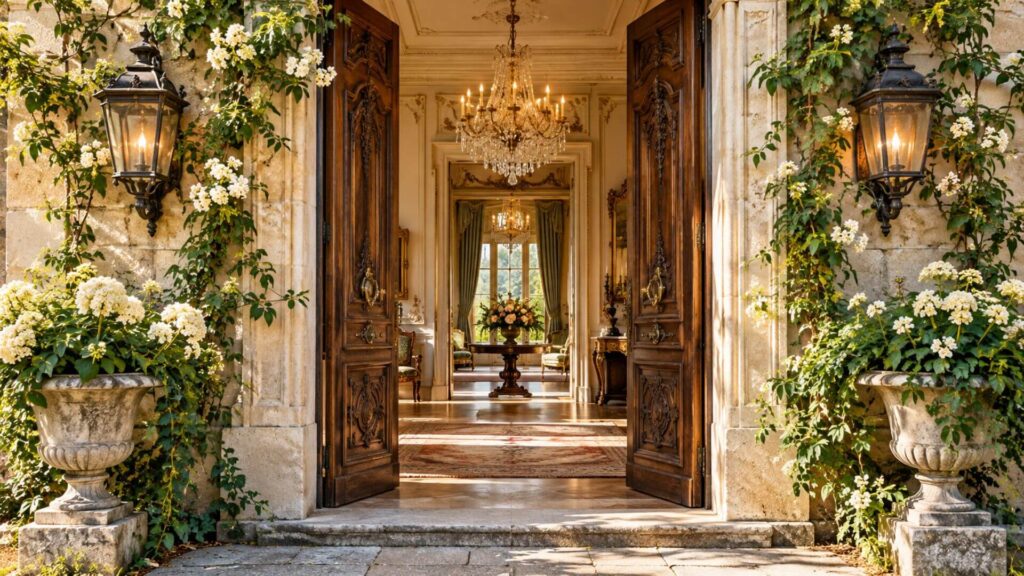
Discover the romance of old-world mansions, the design details that make them unforgettable, and how to bring their timeless elegance into your own home.
What Lies Behind These Doors?
Imagine standing before a magnificent pair of carved wooden doors. Beyond them, a world of extraordinary interiors awaits: richly colored rooms, shimmering chandeliers, velvet furnishings, and elegant passageways that seem to lead from one beautiful discovery to another.
There is something irresistible about a historic manor house. Perhaps it is the sense of mystery, the craftsmanship, or the feeling that every room has a story waiting to be discovered.
But the fascination goes beyond nostalgia.
The beauty of manor house interiors lies in their remarkable ability to feel both centuries old and surprisingly relevant. Their architectural details, luxurious textures, expressive colors, and carefully collected furnishings continue to inspire the way we decorate our homes today.
So what makes these interiors so captivating? And how can we borrow a little of their magic without living in a grand estate?
Curious What Lies Behind These Doors?
Take a visual journey through extraordinary manor-inspired interiors, where old-world grandeur meets modern elegance.
Watch the Manor House Tour on Instagram →
An AI-created visual journey inspired by historic European manor houses and the timeless elegance of old-world interiors.
1. Why Are We Still Fascinated by the Elegance of Old-World Mansions?
The Romance of a Home With History
Walk into a historic manor house, and the first impression is rarely about a single piece of furniture.
It is the atmosphere.
Tall doors create anticipation. Elaborate moldings draw the eye upward. Paintings, mirrors, and decorative objects suggest generations of changing tastes. Beyond one doorway, another room appears, inviting us to explore further.
These interiors offer something that many contemporary homes strive to achieve: a sense of individuality and permanence.
Rather than appearing designed all at once, historic homes often reveal layers of different periods, materials, and artistic influences. Their beauty comes partly from the relationship between those layers.
A carved doorway might frame a room furnished decades later. A traditional portrait may hang beside a more recent piece of art. Rich fabrics soften architectural details that have stood for generations.
The result is a home that feels collected rather than simply decorated.
From European Châteaux to America’s Gilded Age
The fascination with European grandeur has deep roots in American design history.
During the Gilded Age of the late nineteenth century, wealthy American families commissioned remarkable estates inspired by European architecture and decorative traditions.
One celebrated example is Biltmore House in Asheville, North Carolina. George Vanderbilt and architect Richard Morris Hunt drew inspiration from European estates, creating a magnificent château-style residence that opened to guests in 1895.
In Newport, Rhode Island, The Elms was modeled after an eighteenth-century French château, combining historic European elegance with the technological comforts of its own era.
These homes were more than architectural statements. They demonstrated how European influences could be reimagined for American lifestyles.
And that idea remains relevant today: the most interesting interiors do not necessarily belong to a single period. They bring different influences together in a way that feels personal.
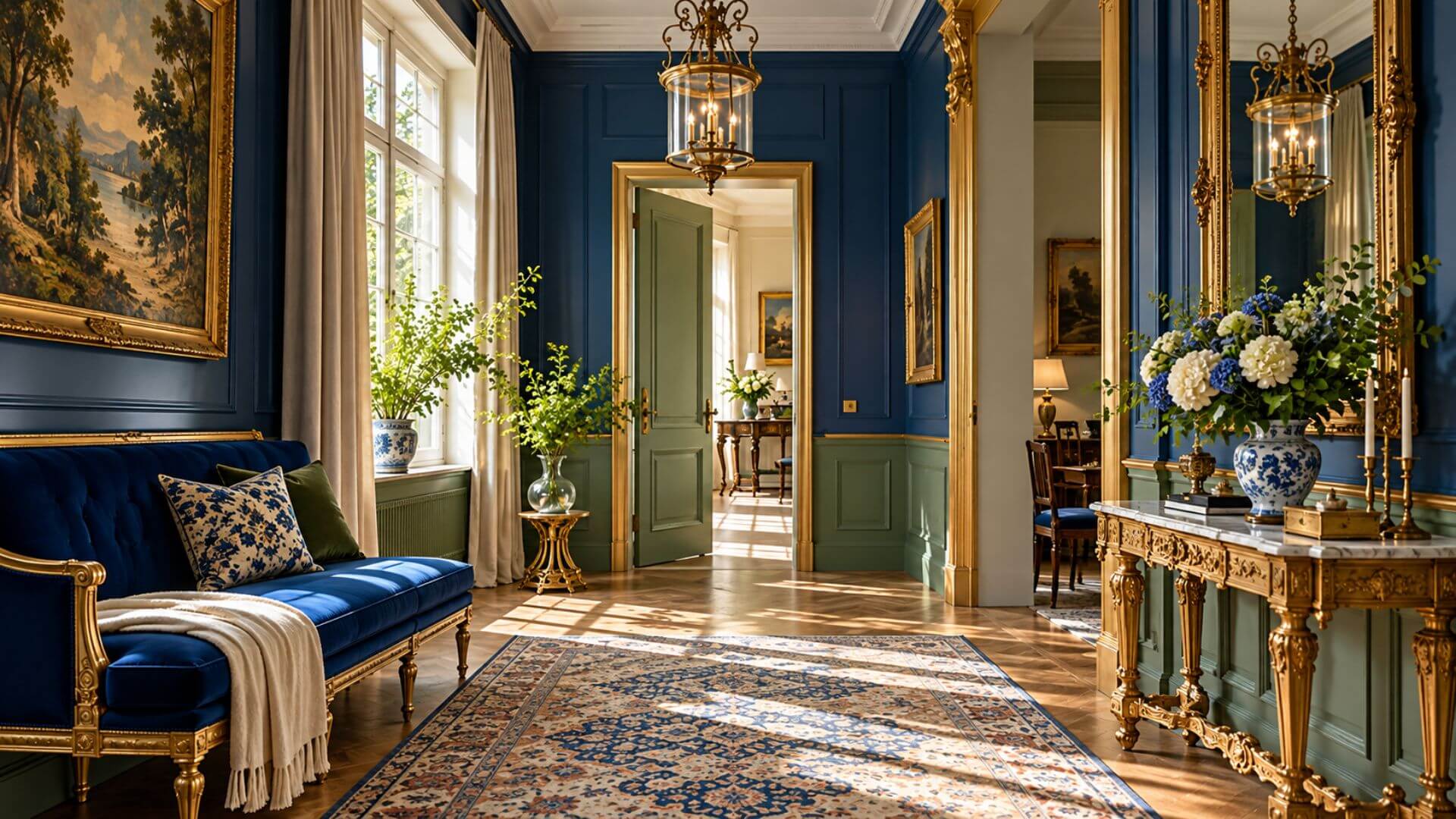
Design inspiration: A beautiful doorway does more than connect rooms. It creates anticipation and turns an ordinary transition into an architectural moment.
2. What Makes These Interiors Feel So Timeless?
Historic manor houses often feature dramatic decoration, yet their most successful rooms feel remarkably balanced.
Their secret is not simply luxury. It is the thoughtful relationship between architecture, color, texture, lighting, and proportion.
Grand Entrances and Beautiful Sightlines
In a grand historic home, the experience often begins before entering the main rooms.
A substantial front door establishes a sense of arrival. Beyond it, a hallway may reveal an elegant staircase, a gilded mirror, or a distant view through another doorway.
These carefully framed views encourage the eye to travel through the home.
The same principle can work in a modern apartment or suburban house. An attractive view from the entryway, a beautifully framed opening, or a carefully positioned piece of furniture can make a space feel more inviting.
Sometimes, the most memorable design feature is not an object but the view it creates.
Color With Confidence
Deep navy, emerald green, burgundy, warm cream, and muted gold have long appeared in richly decorated interiors.
What makes these colors so effective is how they interact.
Dark walls can create intimacy and depth. Cream-colored architectural details provide contrast. Gold finishes reflect warmth, while rich upholstery adds softness.
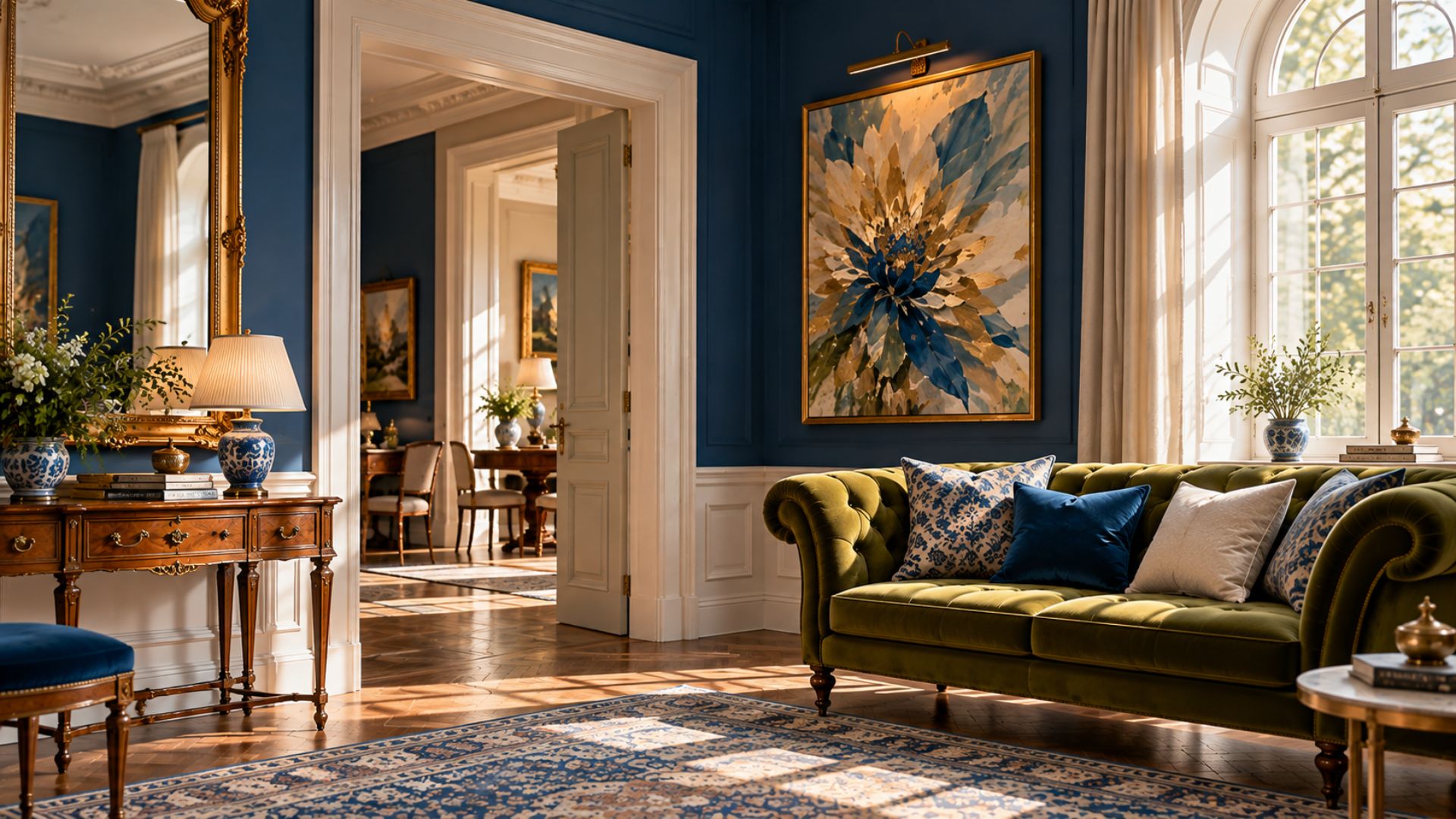
Consider a room with deep blue walls, a green velvet chair, and an antique gold mirror. Each element is distinctive, yet the combination can feel harmonious when the colors are repeated thoughtfully.
The lesson is not to use more color everywhere. It is to use color with intention.
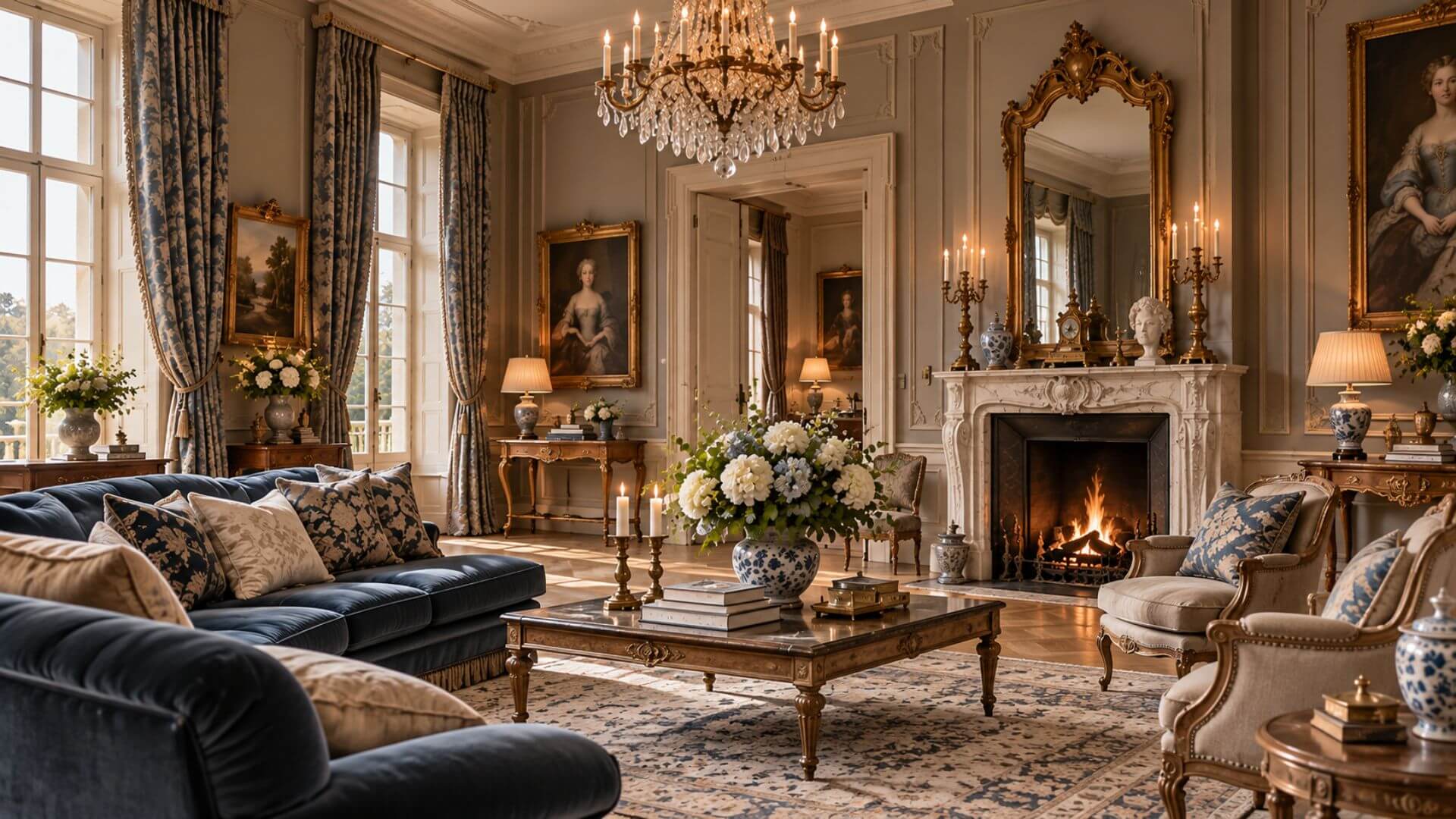
Bring the look home: Pair a deep blue accent with warm brass, cream textiles, and one richly upholstered piece for a refined, manor-inspired palette.
Velvet, Crystal, and the Beauty of Texture
Imagine a room containing only polished stone, gilded wood, and glass. It might be impressive, but it could also feel cold.
Now introduce velvet upholstery, a patterned rug, soft curtains, and warm lamplight.
The atmosphere changes.
Historic interiors frequently relied on contrasts between hard architectural surfaces and softer furnishings. Crystal chandeliers added sparkle, while woven fabrics, upholstered seating, and carpets brought comfort.
This balance remains one of the most useful lessons for contemporary decorating.
A modern living room does not need elaborate plasterwork to benefit from the same idea. Combining smooth, reflective finishes with tactile fabrics can create a layered and inviting space.
Art, Mirrors, and the Pleasure of Discovery
Art has always played an important role in the character of grand interiors.
Portraits, landscapes, decorative panels, and collected objects give rooms a sense of identity. Large mirrors introduce light and create interesting reflections, particularly when positioned opposite windows or architectural features.
But perhaps the most appealing quality of these rooms is that they reward a second look.
There is always another detail to notice: the shape of a frame, the pattern of a carpet, or a small arrangement of flowers beneath a painting.
A thoughtfully decorated home should offer the same pleasure of discovery, even on a much smaller scale.
3. When Old-World Grandeur Meets Modern Design
A Manor House Doesn’t Have to Feel Like a Museum
One of the most exciting ways to interpret historic interiors is to introduce something unexpected.
Imagine an ornate room with decorative wall moldings and antique doors. Instead of furnishing it entirely with traditional pieces, introduce a sculptural modern chair, a contemporary floral painting, or a beautifully simple velvet sofa.
The contrast can be striking.
Historic architecture provides character and depth, while modern furnishings introduce freshness and individuality.
Neither needs to overpower the other.
In fact, the contrast often makes both more interesting.
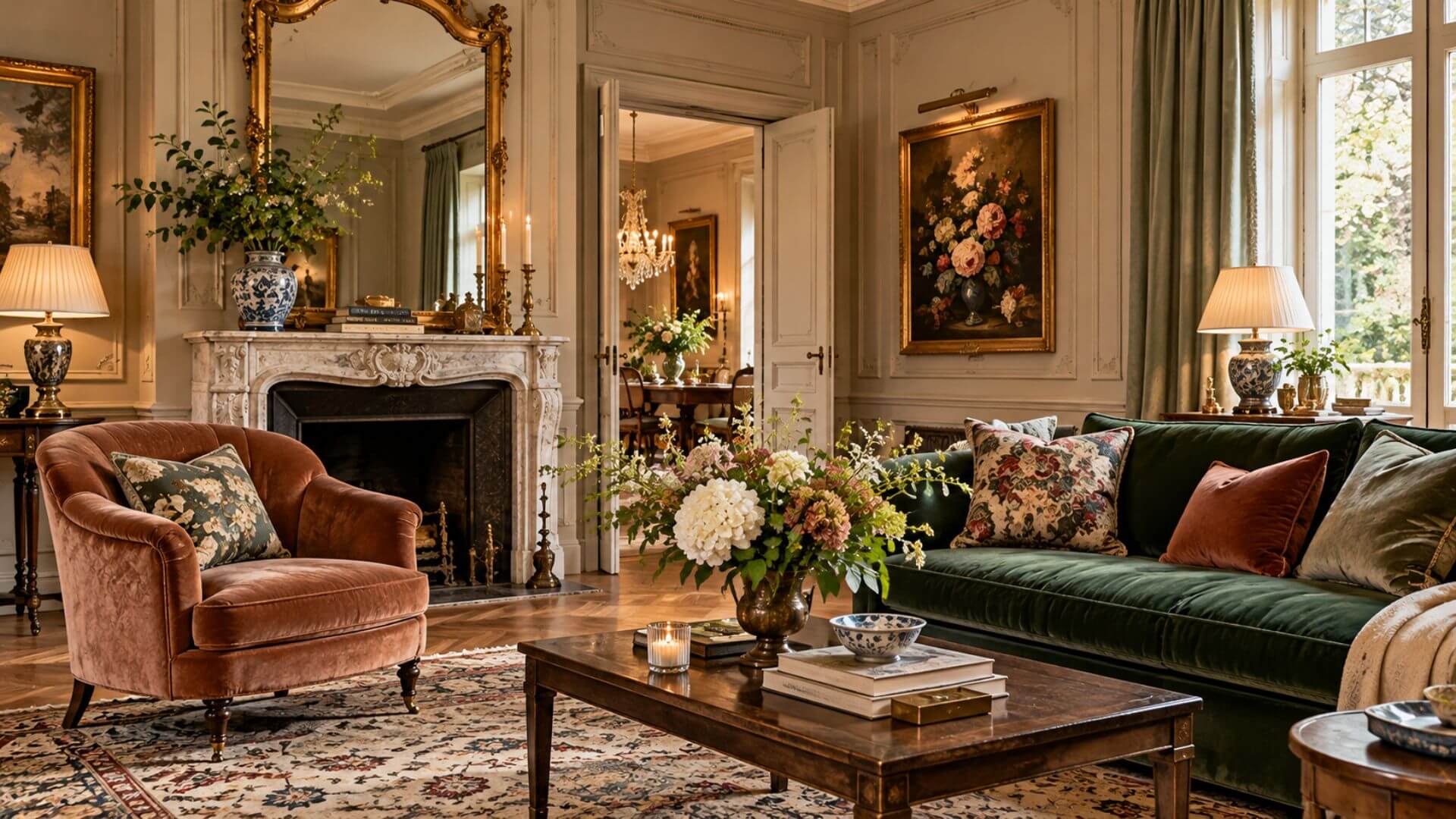
Old-world character meets modern expression: A rich velvet sofa and expressive artwork bring a fresh perspective to a traditionally inspired room.
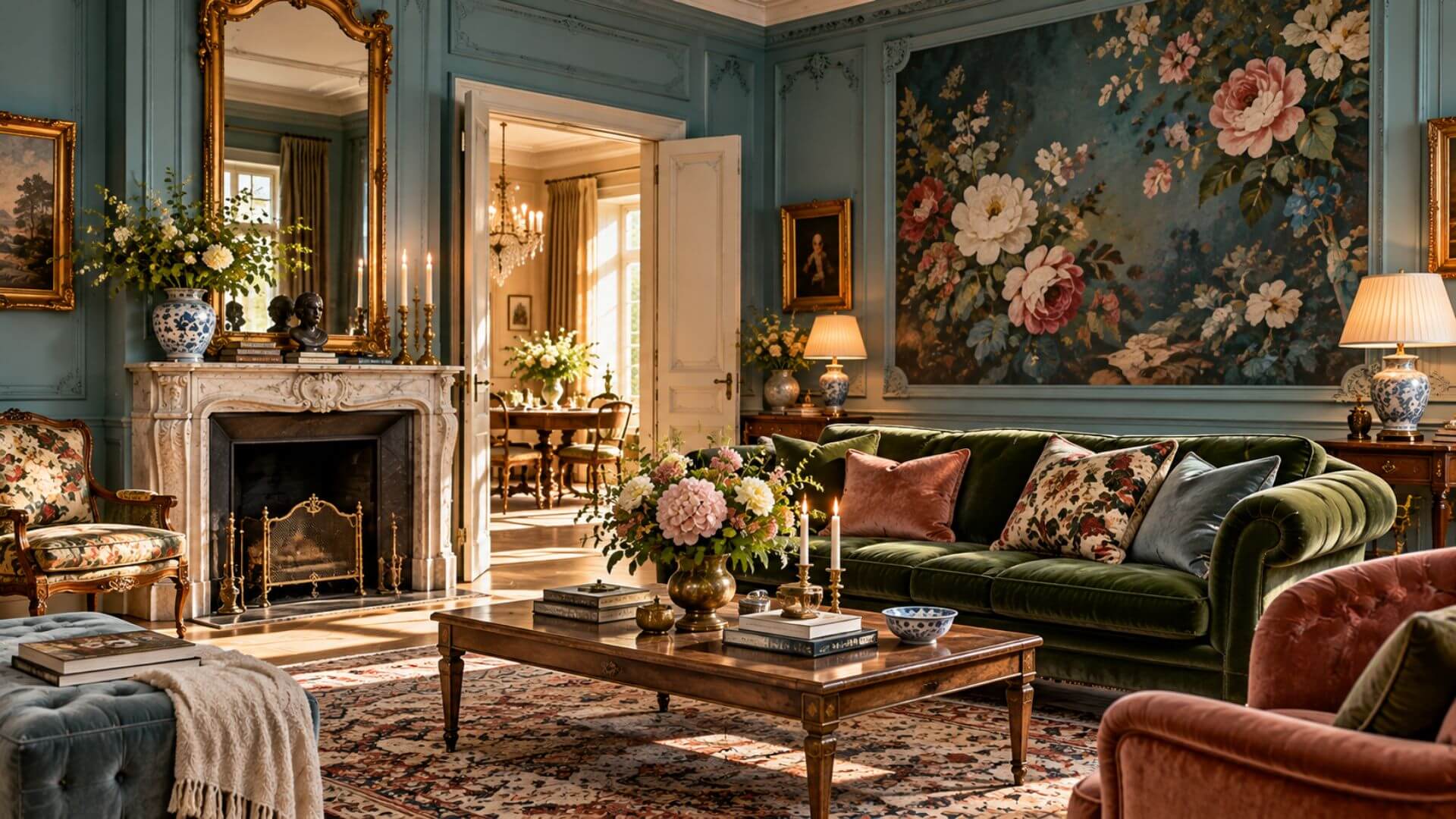
The Unexpected Charm of Turquoise and Floral Art
Not every manor-inspired interior needs subdued colors and antique portraits.
Turquoise walls, vibrant floral paintings, and unusual decorative patterns can introduce a more playful personality.
A bold artwork may feel especially compelling against traditional paneling. A modern floral arrangement can soften a richly decorated room without competing with its architecture.
These unexpected combinations remind us that timeless interiors are not necessarily conservative.
They can be expressive, imaginative, and full of life.
The key is finding a visual connection between old and new, whether through a repeated color, a complementary shape, or a shared sense of elegance.
 The Beauty of Mixing Periods
One of the most enduring interior design principles is that a room becomes more interesting when everything does not look as though it was purchased at the same time.
A contemporary sofa can sit comfortably beneath a vintage mirror. An antique console can become the perfect setting for a modern lamp. A traditional rug may add warmth beneath a minimalist coffee table.
These combinations introduce contrast while giving a home a more personal identity.
Rather than recreating a historical room exactly, borrow the details that speak to you and allow them to become part of your own style.
Design inspiration: Traditional architecture becomes a beautiful backdrop for bold colors and contemporary art.
4. How Can We Bring Manor House Elegance Into Modern Homes?
You do not need soaring ceilings, marble staircases, or a collection of antiques to capture the spirit of manor house living.
Often, the most effective approach is to introduce just one or two carefully chosen elements.
Here are seven ways to bring a little old-world elegance into a contemporary home.
 1. Create a More Memorable Entrance
The entrance sets the tone for the rest of the home.
Try a beautifully framed mirror, a narrow console table, an elegant lamp, or a vase of fresh flowers.
Even a compact hallway can feel special when its details are thoughtfully arranged.
For a more architectural effect, consider painting an interior door in a rich color or adding simple decorative molding where appropriate.
2. Introduce One Statement Light Fixture
A chandelier is one of the most recognizable features of a grand interior, but it does not need to be enormous or elaborate.
A small crystal pendant, an elegant brass chandelier, or a vintage-inspired ceiling fixture can create a focal point in a dining room, bedroom, or living space.
Choose a size that suits the room and allow the light fixture to become part of the overall composition.
3. Add the Soft Luxury of Velvet
Velvet has a remarkable ability to make a room feel richer and more inviting.
An emerald green armchair, a deep blue upholstered bench, or even a few velvet cushions can introduce color and texture.
For a balanced look, combine velvet with simpler materials such as linen, wood, or natural stone.
The contrast helps luxurious fabrics feel sophisticated rather than overly formal.
4. Let an Ornate Mirror Become the Focal Point
A decorative mirror can bring historical character into an otherwise contemporary interior.
Try a vintage-style gold mirror above a streamlined console or a carved wooden mirror against a softly painted wall.
The contrast between an ornate frame and simpler furniture creates a beautiful balance.
Mirrors can also reflect daylight and make a smaller space feel more open.
5. Choose Art That Tells a Story
Art is one of the easiest ways to introduce personality.
A dramatic floral painting, a landscape, an antique-inspired print, or a contemporary abstract piece can transform a room.
Do not feel that traditional furniture requires traditional artwork.
Sometimes, a bold modern painting is exactly what makes a classic interior feel fresh.
6. Build a Rich but Balanced Color Palette
Manor-inspired color does not have to mean dark walls throughout the house.
Start with a calm foundation such as warm ivory, greige, or soft taupe.
Then introduce one deeper color: navy, moss green, burgundy, or muted teal.
Finish with a small amount of brass, aged gold, or dark wood for warmth.
The result can feel elegant and layered without becoming visually heavy.
7. Layer Textiles for Comfort and Character
Patterned rugs, curtains, upholstered seating, and decorative cushions can bring a sense of history to modern spaces.
Choose a rug that anchors the furniture and introduces subtle pattern. Add curtains that soften the windows, and combine fabrics with different textures.
The goal is not to recreate a formal drawing room but to make the space feel warm, comfortable, and thoughtfully collected.
Bring the look home: One statement piece, a layered color palette, and a few carefully chosen textures can create the feeling of timeless elegance without overwhelming the room.
The Beauty of a Home With a Story
Perhaps the greatest lesson we can learn from historic manor houses is that beautiful interiors are about more than decoration.
They are about atmosphere, craftsmanship, individuality, and the pleasure of discovering something new.
The grand estates of the past may have been designed on an extraordinary scale, but their most appealing qualities are surprisingly accessible.
A beautifully framed doorway. A favorite painting. A velvet chair in an unexpected color. A mirror that catches the afternoon light.
These small details can make a home feel distinctive, welcoming, and deeply personal.
You don’t need a grand estate to embrace the beauty of manor living.
Sometimes, all it takes is one remarkable piece, a rich color, or a detail that makes your home feel like it has a story to tell.